

AI Deploy - Stratégies de mise à l'échelle (EN)
259 vues
 18.03.2026
  AI Deploy
AI Deploy is covered by OVHcloud Public Cloud Special Conditions.
Objective
This guide provides a comprehensive understanding of the different scaling strategies for AI Deploy. The objective is to explain the differences between static scaling and autoscaling, guide users on how to choose between them, set them during app creation, and explain how to modify scaling strategies once apps are created.
Requirements
- An active Public Cloud project.
- The OVHcloud AI CLI (
ovhai) installed. For installation instructions, see how to install ovhai.
OVHcloud Control Panel Access
- Direct link: Public Cloud Projects
- Navigation path:
Public Cloud> Select your project
Scaling principles
When creating an application via the OVHcloud Control Panel (UI) or the ovhai CLI, you can choose one of two scaling strategies:
- Static Scaling: Fixed number of running replicas.
- Autoscaling: Dynamic replicas based on usage metrics (CPU/RAM or custom metrics).
Static Scaling
What is Static Scaling?
Static scaling allows you to configure a fixed number of replicas (identical instances of your application) running at all times. This is the default strategy if not specified.
The minimum number of replicas is 1 and the maximum is 10.
For High Availability, it is strongly recommended to deploy a minimum of 2 replicas.
When to choose Static Scaling?
- You have predictable, consistent workloads.
- You prefer fixed, predictable costs with no unexpected resource usage spikes.
- Your use case requires minimal latency, as replicas are always active.
Setting Static Scaling (UI and CLI)
When creating your application, you will have the opportunity to choose your scaling strategy. By default, the strategy is set to static scaling. To use this strategy, make sure that automatic scaling is not enabled. Then, you will be asked to choose the number of replicas on which your application will run.
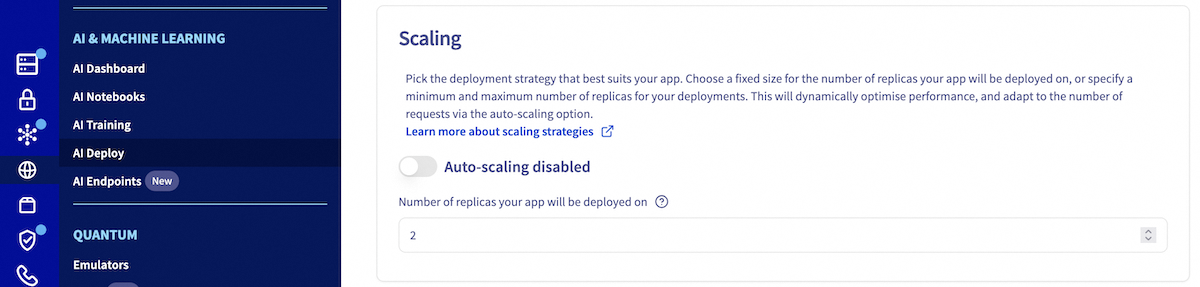
Use the ovhai app run command with the --replicas parameter to set the number of replicas at deployment:
Autoscaling
What is Autoscaling?
Autoscaling dynamically adjusts the number of application replicas based on real-time metrics, such as CPU or RAM usage. This is optimized for workloads with varying demand.
Autoscaling adjusts by calculating the average resource usage across all replicas. If the average exceeds the threshold, new replicas are added after the scaling up delay; if it falls below, replicas are removed after the scaling down delay.
Autoscaling Key Configuration Parameters
Using this strategy, it is possible to choose:
| Parameter | Description |
|---|---|
| Minimum Replicas | Lowest number of running replicas. When set to 0, the number of replicas will be reduced to 0 when your application no longer receives calls during the defined period, limiting costs of your app. |
| Maximum Replicas | Upper bound for replica count (define based on usage expectations). |
| Time before scaling down (s) | Number of seconds before scaling from N to N-1 replicas. Default value is 300s. Must be greater than or equal to 0 and less than or equal to 3600 (one hour). |
| Time before scaling to 0 (s) | Number of seconds before reducing from 1 to 0 replica. Only applies when minimum replicas is set to 0. When enabled, this time must be considered in addition to the Time before scaling down parameter. |
| Time before scaling up (s) | Number of seconds before scaling from N to N+1 replicas. Default value is 0s. Must be greater than or equal to 0 and less than or equal to 3600 (one hour). |
| Monitored Metric | The metric to be monitored. Choose between CPU, RAM or a custom metric for triggering autoscaling actions. |
| Trigger Threshold (%) | Average usage percentage used to trigger scaling up or down. Range: 1–100%. |
For High Availability, it is strongly recommended to deploy a minimum of 2 replicas.
If you set the minimum number of replicas to 0, please consider the following:
-
Scaling behavior: If there is no traffic to it, your app will scale down to zero replicas.
-
Cold start latency: If a request comes in while no replicas are serving your app, there will be a cold start delay before the app starts serving requests again, varying from 30 seconds to several minutes depending on your image and volume weight.
-
Resource availability risk: If you use a popular flavor, then there is a risk that your app will NOT be able to scale up again, if flavor is unavailable, preventing your app from handling incoming requests.
-
Parameter interaction: The time before scaling to 0 is applied in addition to the time before scaling down. This means the total time before an app scales down to 0 is the sum of both parameters.
When to Choose Autoscaling?
- Your app has irregular or fluctuating inference/load patterns.
- You want to scale cost-effectively with actual usage.
- You are managing a high-throughput application with sudden demand spikes.
Setting Autoscaling (UI and CLI)
When creating your application, you will have the opportunity to choose your scaling strategy. By default, the strategy is set to static scaling. Toggle the button to switch to Autoscaling Then, configure minimum/maximum replicas, metric, and threshold.
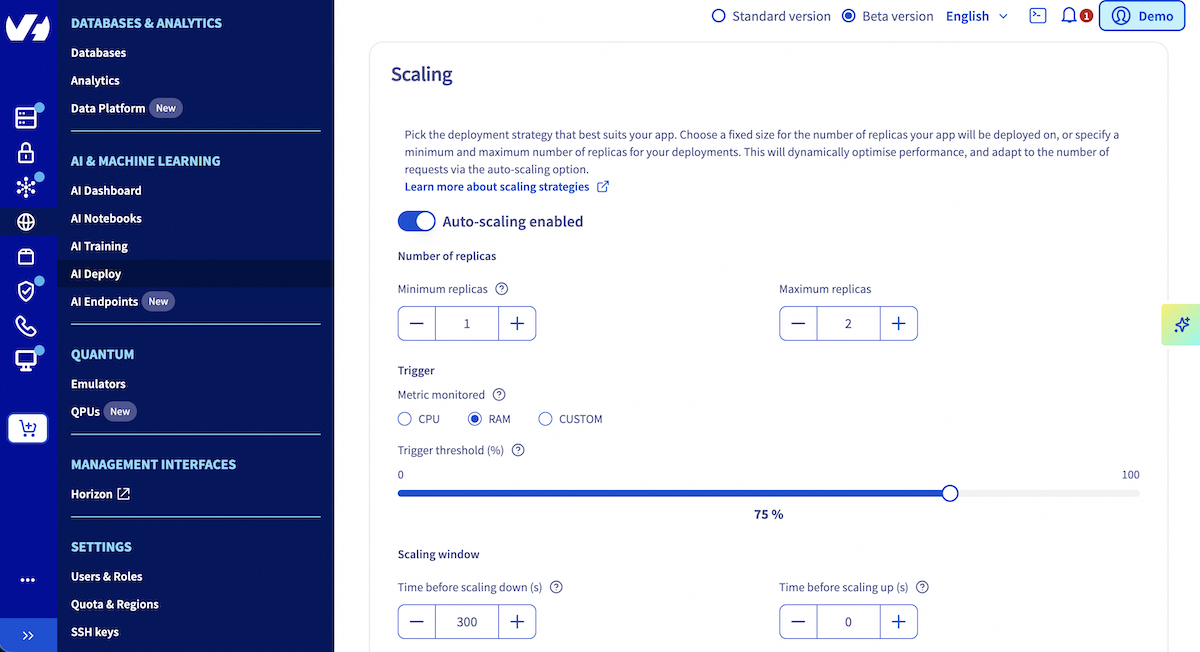
Use the ovhai app run command with the following autoscaling parameters:
Advanced: Custom Metrics for Autoscaling
For advanced scenarios, you can define custom metrics to drive autoscaling decisions. This is recommended for workloads such as GPU based inference where CPU and RAM usage provide an incomplete picture of the system's performance or request load.
This feature can be used through the UI and CLI, and requires an API endpoint to fetch metrics from.
To enable custom autoscaling, select CUSTOM as the monitored metric in the UI, during the Scaling step. Then, you will need to fill several fields:
- Metric URL: URL of the API operation to call to get the metric value. A specific
<SELF>placeholder can be given whenever metrics API is served by the deployed app itself. - Data format: Format of the metric to scale on (
JSON,XML,YAML,PROMETHEUS). Default isJSON. - Data location: Location of the metric value in the response payload. This value is format-specific. See the valueLocation from the parameters list in the Trigger Specification documentation for details.
- Target value of the metric: Target value for metric to scale on. When the metric provided by the API is equal to or greater than this value, scaling occurs upwards. If the metric is less than or equal to 0, scaling is brought back to 0. This value can be a decimal number.
- Aggregation type: Type of aggregation to perform before comparing the aggregated metric value to the target value. For example, if you choose AVERAGE, the value compared to the target value for scaling will be the average of the metric values from each replica of your AI Deploy app. Options are (
AVERAGE,MIN,MAX,SUM). Default isAVERAGE.
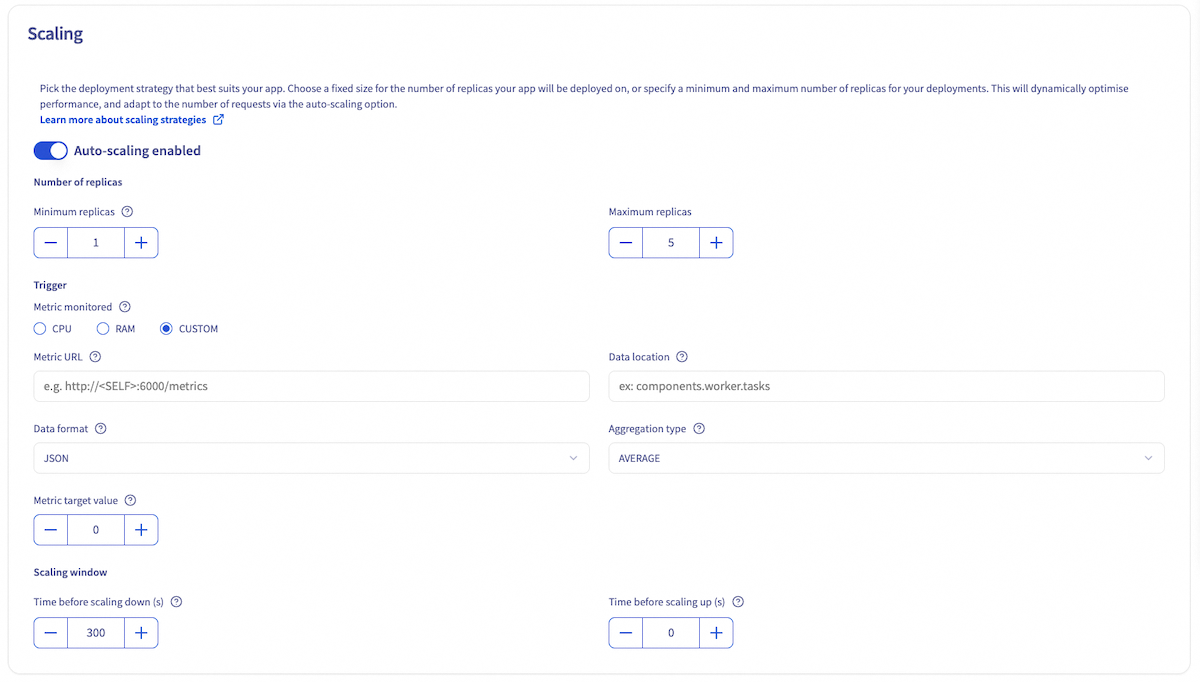
Use the ovhai app run command with the following parameters:
| Parameter | Description |
|---|---|
--auto-custom-api-url | URL of the API operation to call to get the metric value. A specific <SELF> placeholder can be given whenever metrics API is served by the deployed app itself. |
--auto-custom-metric-format | Format of the metric to scale on (JSON, XML, YAML, PROMETHEUS). Default is JSON. |
--auto-custom-value-location | Location of the metric value in the response payload. This value is format-specific. See the valueLocation from the parameters list in the Trigger Specification documentation for details. |
--auto-custom-target-value | Target value for metric to scale on. When the metric provided by the API is equal to or greater than this value, scaling occurs upwards. If the metric is less than or equal to 0, scaling is brought back to 0. This value can be a decimal number. |
--auto-custom-metric-aggregation-type | Type of aggregation to perform before comparing the aggregated metric value to the target value. For example, if you choose AVERAGE, the value compared to the target value for scaling will be the average of the metric values from each replica of your AI Deploy app. Options are (AVERAGE, MIN, MAX, SUM). Default is AVERAGE. |
Example:
Scaling based on a custom metric from an internal endpoint:
Modifying Scaling Strategies Post-Deployment
You can also modify the scaling strategy after the app has been created using the Control Panel UI or the ovhai app scale CLI command.
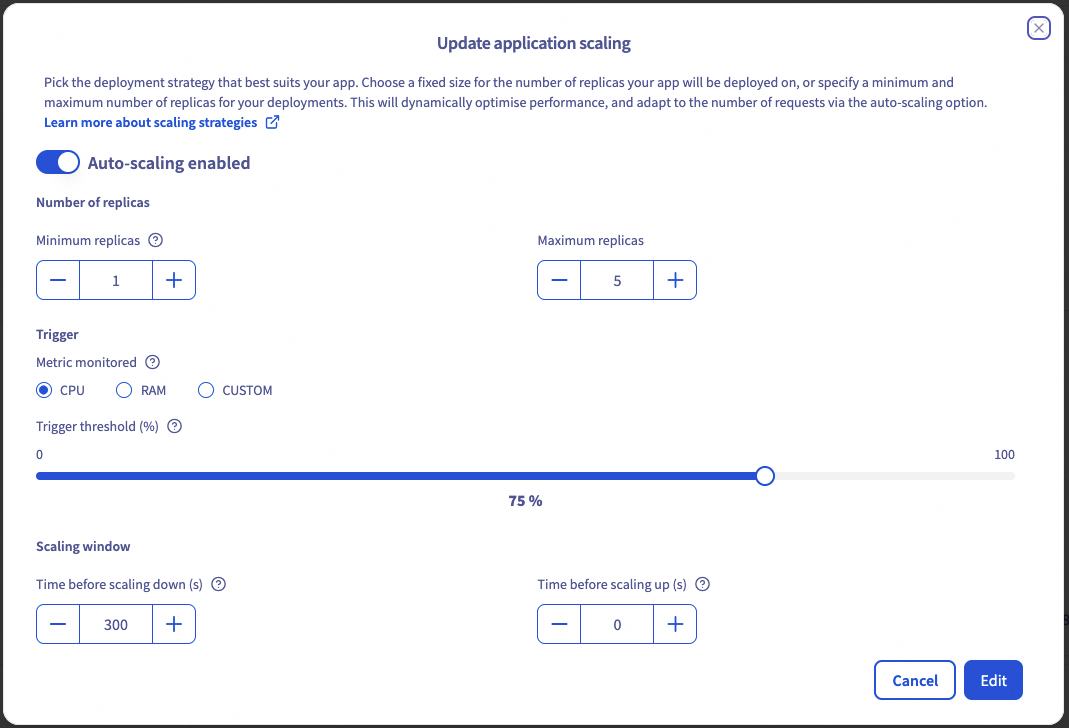
To modify scaling strategies through the UI, navigate to your application details page by clicking on its name in the AI Deploy section. On this page, you will find general information about your application, including a Resources section.
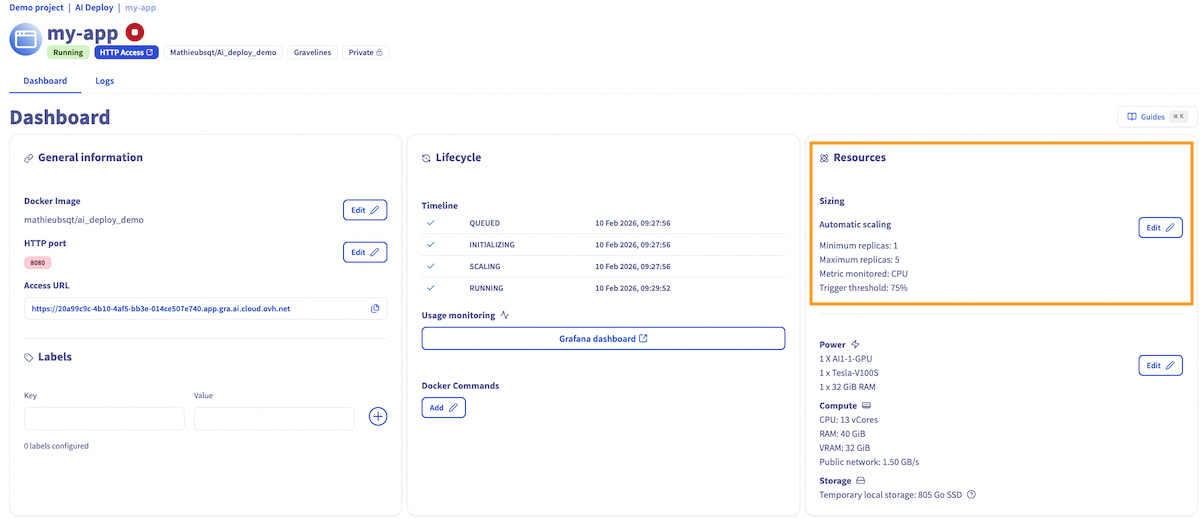
In this window, click the Edit button to access scaling configuration options. This will open an Update application scaling window where you can:
- Switch between auto scaling and static scaling
- Change replica values
- Modify monitored metric and associated values
- Update your scaling window (time to scale up, to scale down or to scale to 0)
To modify scaling strategies through the CLI, use the ovhai app scale command with appropriate parameters:
Updating Static Scaling
To change the number of replicas for a static scaling strategy, use the ovhai app scale command with the --replicas parameter:
Updating Autoscaling
To change the autoscaling parameters, use the ovhai app scale command with the following parameters:
Updating Autoscaling using a custom metric
Available options for Fixed Scaling Strategy:
Scaling examples
We will use the following example:
In case an app is based on the AI1-1-CPU flavor with a resource size of 2 (i.e. 2 CPUs), this means that each replica of the application will be entitled to 2 vCores and 8GiB RAM.
Example 1
First, we choose an Autoscaling.
Then we set the trigger threshold to 75% of CPU.
In this case, the app will be scaled up when the average CPU usage across all its replicas is above > 1.5 CPU (2*0.75), and it will be scaled down when the average CPU usage falls below < 1.5.
Example 2
In this second example, we choose an Autoscaling.
Then we set the trigger threshold to 60% of RAM.
In this example, the app will be scaled up when the average RAM usage across all its replicas is above > 4.8 GB (8*0.60), and it will be scaled down when the average RAM usage falls below < 4.8 GB again.
The total deployment price for autoscaling apps is calculated based on the minimum number of replicas, but costs can increase during scaling.
Conclusion
Choosing the right scaling strategy is critical for balancing cost, performance, and reliability in your AI Deploy applications. Static scaling offers stability and predictability, while autoscaling provides flexibility for dynamic workloads.
Feedback
Please feel free to send us your questions, feedback and suggestions to help our team improve the service on the OVHcloud Discord server
If you need training or technical assistance to implement our solutions, contact your sales representative or click on this link to get a quote and ask our Professional Services experts for a custom analysis of your project.


 AI Deploy - Portfolio d'app (EN)
 305
305