

Configuring vRack for Public Cloud using OpenStack CLI
62 Views
 13.01.2025
  Cloud / Network Gateway for Public Cloud
Objective
The OVHcloud vRack is a private network solution that enables our customers to route traffic between OVHcloud dedicated servers as well as other OVHcloud services. At the same time, it allows you to add Public Cloud instances to your private network to create an infrastructure of physical and virtual resources.
This guide provides some basic information on creating and configuring the vRack on Public Cloud using OpenStack CLI.
Requirements
- A Public Cloud project in your OVHcloud account
- An OpenStack user account (Optional)
- Basic networking knowledge
- Consulting the guide Configuring the vRack on Public Cloud (to understand the different methods to manage the vRack with the Public Cloud)
Before you get started, make sure you read these guides to properly setup your OpenStack environment:
Instructions
OVHcloud Control Panel Access
- Direct link: Public Cloud Projects
- Navigation path:
Public Cloud> Select your project
Content overview
- Step 1: Activating and managing a vRack
- Step 2: Creating a private network in the vRack
- Step 3: Integrating an instance into vRack
- Removing a network interface
Step 1: Activating and managing a vRack
vRack is managed at the OVHcloud infrastructure level, meaning you can only administrate it in the OVHcloud Control Panel and the OVHcloud APIv6.
In the OVHcloud Control Panel
This does not apply to newly created projects which are now automatically delivered with a vRack. To view the vRack once the project has been created, open the Network menu in the left-hand sidebar and click on vRack private network to view the vRack(s).
If you have an older project and don't have a vRack, you need to order one. Using the vRack itself is free of charge and it can be delivered within a few minutes.
Click the button Add a service (shopping cart icon) in the left-hand menu. Use the filter at the top of the page or scroll down to find the service vRack.
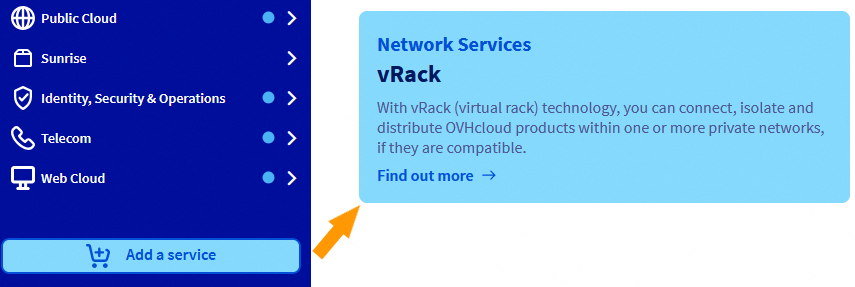
You will be redirected to another page to validate the order, it will take a few minutes for the vRack to be setup in your account.
Once the service is active, you will find it under Public Cloud > your project > Network > vRack private network. Labelled "pn-xxxxxx".
From the list of eligible services, select the project you want to add to the vRack and click the Add button.
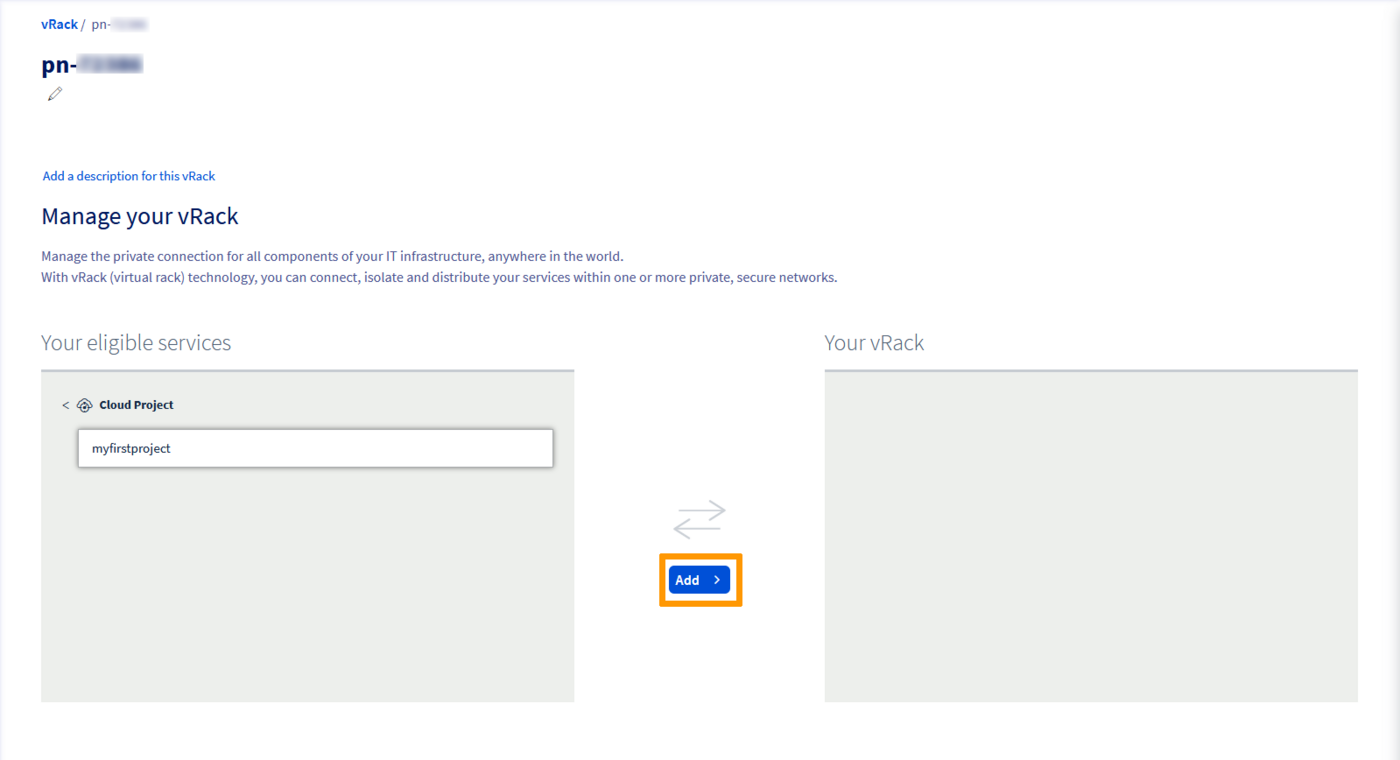
With the OVHcloud APIv6
To activate and manage a vRack using the OVHcloud APIv6, please refer to this section of the corresponding guide.
Step 2: Creating a private network in the vRack
It is necessary to create a private network with a virtual local area network (VLAN) so that the connected instances can communicate with each other.
With the Public Cloud service, you can create up to 4,000 VLANs within one vRack. This means that you can use each private IP address up to 4,000 times. Thus, for example, 192.168.0.10 of VLAN 2 is different from IP 192.168.0.10 of VLAN 42. This can be useful in order to segment your vRack between multiple virtual networks.
In order to create the same private network, we need to create 2 OpenStack objects: network and subnet.
In the following example we specify the VLAN_ID to which we want the network to be part of through --provider-network-type and --provider-segment.
You can remove those parameters. In that case, an available VLAN_ID will be used.
Step 3: Integrating an instance into vRack
To intergrate an instance into the vRack, you need to link it to a private network.
There are two possible scenarios:
- The instance to be integrated does not exist yet.
- An existing instance needs to be added to the vRack.
In case of a new instance
The following steps are necessary to create an instance directly in the vRack.
Retrieving the required information
Public and private networks:
or
You will need to note the network IDs of interest:
- Ext-Net for a public IP address
- The VLAN(s) required for your configuration
Also note the information detailed in this guide:
- ID or name of the OpenStack SSH key
- ID of the instance type (flavor)
- ID of the desired image (operating system, snapshot, etc.)
Deploying the instance
With the previously retrieved items, an instance can be created, including it directly in the vRack:
Example:
or
Example:
You can set the IP address of the instance of your vRack interface at the OpenStack level.
To do this, you can add a single argument to the function "--nic":
--nic net-id=[ID-Network],v4-fixed-ip=[IP_static_vRack]
Example:
--nic net-id=[ID-vRack],v4-fixed-ip=192.168.0.42
Verifying the instance
After a few moments you can check the list of existing instances to find the server you created:
In case of an existing instance
The following steps are necessary to integrate an existing instance into the vRack.
Retrieving the required information
Identify your instances:
or
Public and private networks:
or
You will need to note the network IDs of interest:
- Ext-Net for a public IP address
- The VLAN(s) required for your configuration
Adding a private network interface
In order to attach a new interface, execute the following command:
Example:
You can verify that the action has been performed:
or
Removing a network interface
Detaching a network interface is permanent.
However, it is important to note that if you detach the "Ext-Net" interface (public IP), this address will be released and put back into circulation. It is not possible to just reassign it.
This action is only required if you wish to isolate your server in the vRack (private network), or if you wish to remove it from one or more VLANs.
In order to detach an interface, you will first need to identify the Neutron port that has been created.
You can do this by using the following commands:
or
Once you have identified the port to remove, you can execute the following command:
Example:
Go further
Configuring vRack for Public Cloud using OVHcloud APIv6.
Creating multiple vLANs in a vRack.8
If you need training or technical assistance to implement our solutions, contact your sales representative or click on this link to get a quote and ask our Professional Services experts for assisting you on your specific use case of your project.
Join our community of users.


 Creating a private network with Gateway
 94
94