

Migrate from Gen 2 to Gen 3 for Public Cloud Databases
41 Ansichten
 09.10.2025
  Cloud / MANAGED_SERVICES
Objective
OVHcloud Public Cloud Databases offer different generations to meet varying needs for performance, scalability, and features. This guide is specifically designed to walk you through the migration of your existing database service from Gen 2 to Gen 3. You'll discover the detailed steps to perform this upgrade, taking advantage of improved performance, enhanced features, and better reliability for your critical applications.
Requirements
- A Public Cloud project in your OVHcloud account
- An existing Gen 2 database service deployed
- Access to the OVHcloud API (optional)
OVHcloud Control Panel Access
- Direct link: Public Cloud Projects
- Navigation path:
Public Cloud> Select your project
Why migrate to Gen 3?
Upgrading your database service from Gen 2 to Gen 3 brings significant improvements in performance, scalability, and reliability. Gen 3 databases are designed with enhanced architectures and optimised resource management, allowing your critical applications to run more efficiently and with better fault tolerance.
Instructions
OVHcloud Public Cloud Databases exist in several generations that reflect the evolution of their underlying infrastructure.
- Gen 2 flavors are named DB2-X for MongoDB and DB1-X for other database engines. They are based on Compute Instance General Purpose B2 and Discovery D2 families.
- Gen 3 flavors follow the same naming convention as Compute Instance General Purpose B3 (b3-X), on which they are built.
Gen 3 provides improved performance, scalability, and reliability compared to Gen 2.
Migrate a database service from Gen 2 to Gen 3
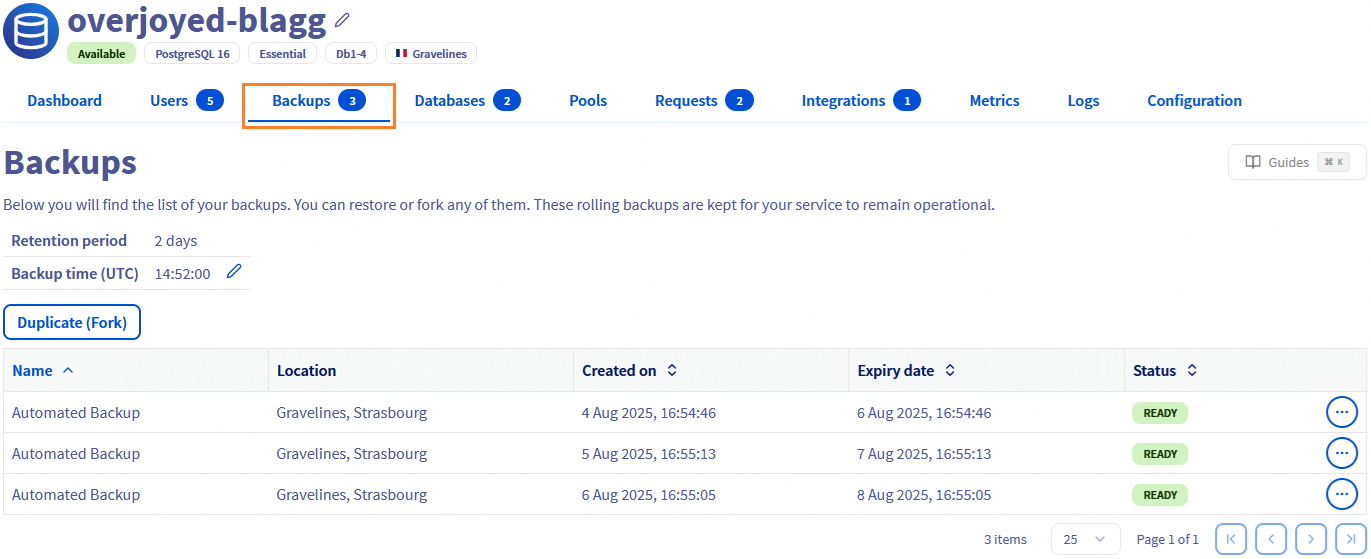
Click Databases in the left navigation bar, select your database service then click the Backups tab.
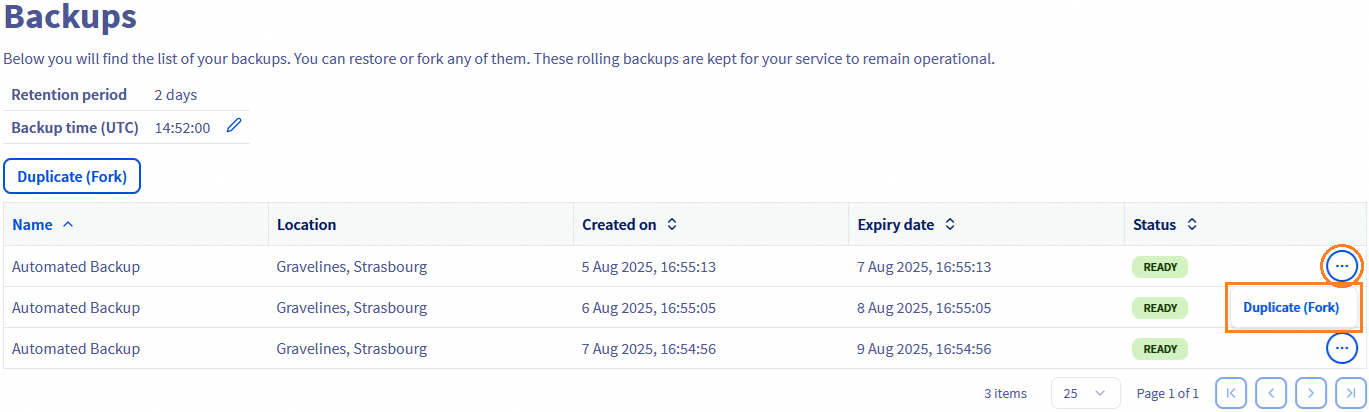
Choose the backup from which you wish to fork, click the ... button then the Duplicate (fork) button.
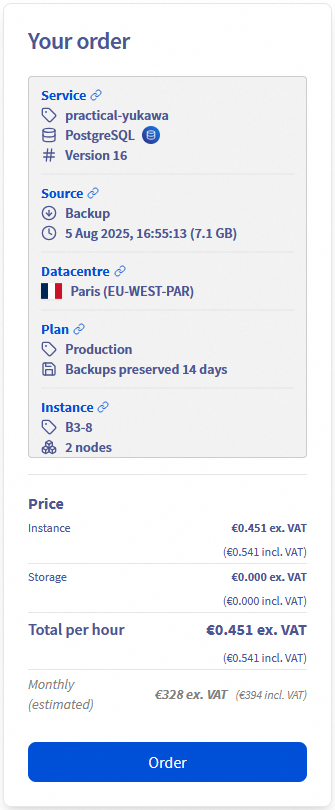
The page that appears allows you to configure your service and choose the destination region.
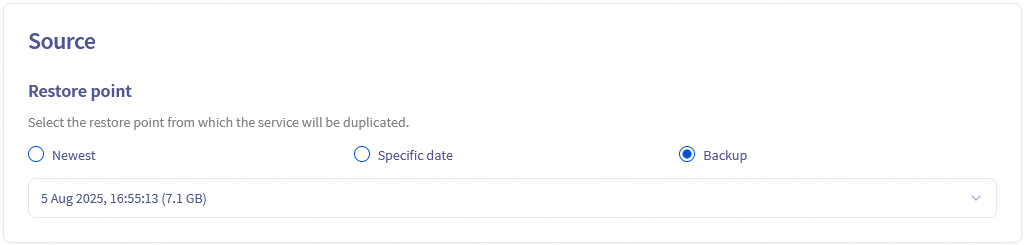
Select the Restore point named Backup.
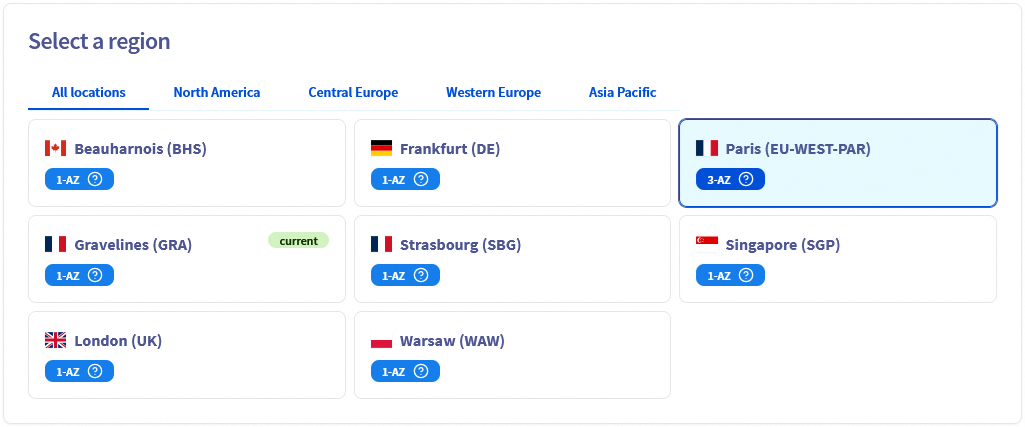
Select a region.
Select a service plan.
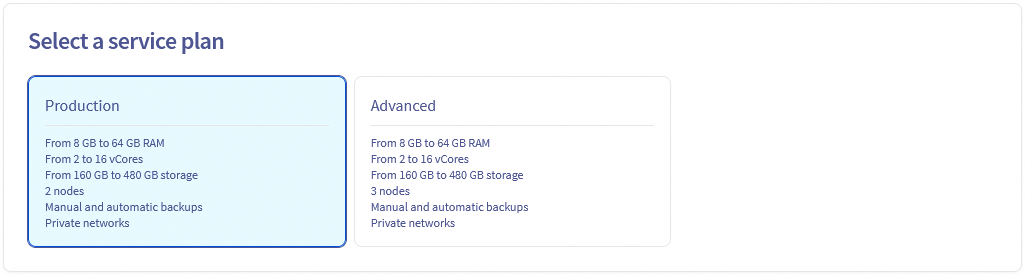
Select the instance that will host the service.
Plan mapping and considerations when migrating to Gen 3:
- Business (Gen 2) -> Production (Gen 3)
- Enterprise (Gen 2) -> Advanced (Gen 3)
- Essential (Gen 2) -> No direct Gen 3 equivalent. Essential plans used a single node, whereas all Gen 3 plans have a minimum of 2 nodes.
Migrating from an Essential plan will require selecting a different plan in Gen 3, which increases the cost due to the additional node. Even for Business and Enterprise plans, Gen 3 nodes provide higher redundancy and performance (2–3 nodes depending on the plan).
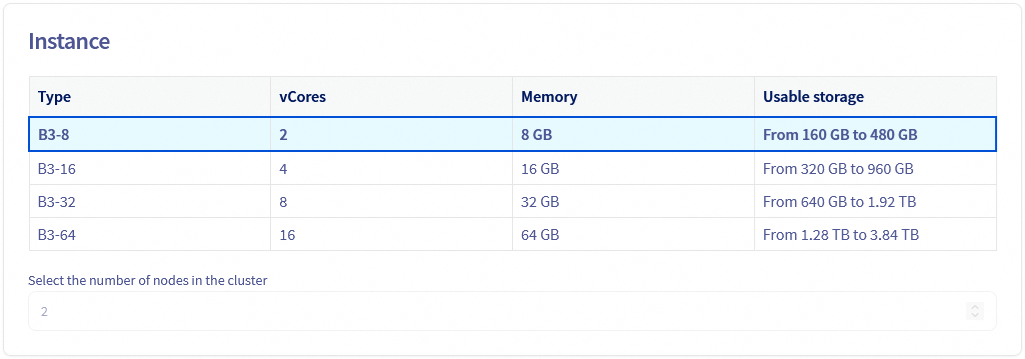
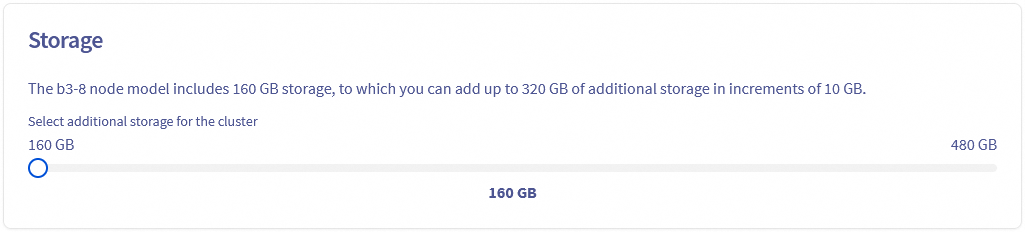
Select the storage capacity of the service.
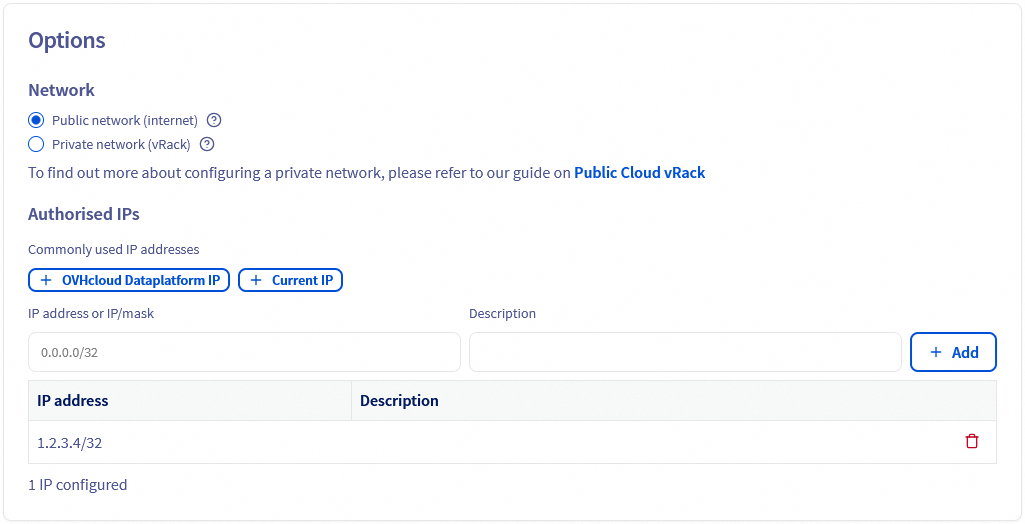
If needed, you can edit the connectivity settings, then verify the IP addresses to whitelist (the list is pre-filled by default with the origin service's configuration).
When you have completed your configuration, review your order then click on the Order button.
To interact with your Public Cloud Databases services via the OVHcloud API, make sure you've mastered the basics first by consulting our guide: Public Cloud Databases - Getting started with APIs.
To find the backup ID of a service, use the following API call:
This call retrieves the backup list of the concerned service. They are listed in order from the most recent backup to the oldest.
If you want to check the information on a particular backup, you can use this API call:
To create your new service from one backup, use the following API call:
An example of a body for this API call:
The field named backup is deprecated and replaced by forkFrom.
Validate the deployment
After your new Gen 3 database service has been successfully provisioned, it's crucial to validate its deployment and ensure your applications can connect to it.
- Test the connection to your new service:
- Use a database client (e.g., psql for PostgreSQL, mysql for MySQL) or a simple script to verify that you can connect to the new Gen 3 service endpoint using its credentials.
- Confirm that your data has been successfully restored from the backup and is accessible.
- Configure your application to use the new service:
- Update your application's configuration files or environment variables to point to the new Gen 3 database service connection string (host, port, username, password).
- Restart your application to apply the changes.
- Thoroughly test your application's functionality to ensure it operates correctly with the new database endpoint.
Clean up
Once you've fully validated that your application is working correctly with the new Gen 3 database service, and you're confident all data has been transferred and is accessible, you can proceed with deleting the old Gen 2 service.
This step is crucial to avoid unnecessary costs and maintain a clean infrastructure.
Follow these instructions to delete the old 1-AZ service:
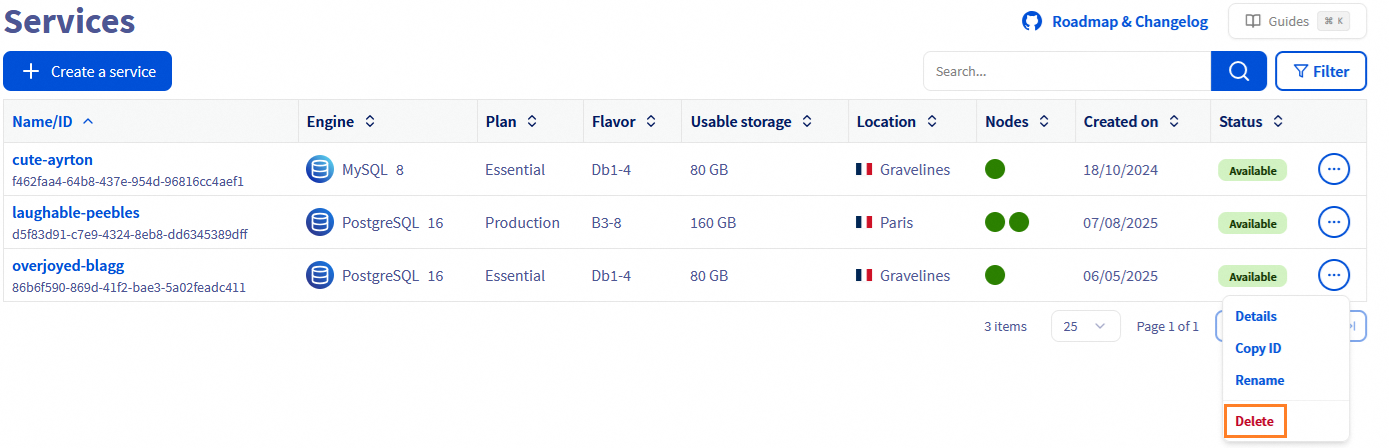
Navigate to your list of database services, click the ... button on the service line then click the Delete button to permanently delete the service.
To delete your service, use the following API call:
We want your feedback!
We would love to help answer questions and appreciate any feedback you may have.
If you need training or technical assistance to implement our solutions, contact your sales representative or click on this link to get a quote and ask our Professional Services experts for a custom analysis of your project.
Are you on Discord? Connect to our channel at https://discord.gg/ovhcloud and interact directly with the team that builds our databases service!


 Migrate from a Single AZ to a 3-AZ region for Public Cloud Databases
 56
56